
Over the past few years, marketing automation has continued to evolve as a core business practice.
Businesses are no longer simply sending scheduled emails to large lists of customers. Modern marketing teams want to create personalised customer journeys, respond to customer behaviour, connect campaigns to sales activity, and communicate across multiple channels.
This is where Marketing Automation becomes particularly valuable.
Odoo already provides a visual campaign builder that allows businesses to segment audiences, create multi-step workflows, trigger actions based on customer behaviour, and monitor campaign performance. Its current Marketing Automation application supports email, SMS, CRM, eCommerce, Events, Helpdesk and other business processes.
With Odoo 20, however, the Marketing Automation experience is expected to become considerably more sophisticated.
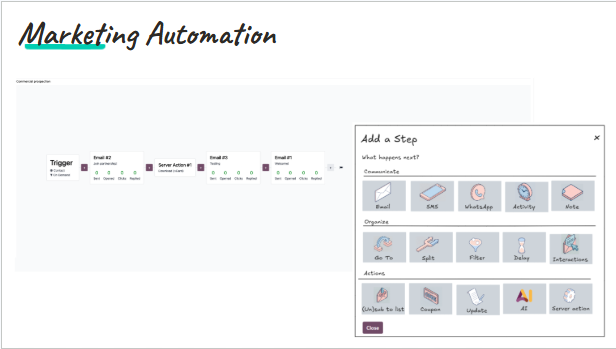
Information presented during Odoo Partner Days 2026 points towards a significant expansion of the campaign workflow builder, including WhatsApp, AI actions, coupons, splits, filters, delays, interactions, and additional automation steps. Other roadmap information also points towards dynamic mailing lists, new mailing blocks and templates, and stronger connections between Marketing Automation and the wider Odoo ecosystem.
For marketing teams using Odoo—or businesses considering Odoo as their ERP and marketing platform—these changes are worth paying attention to.
What Is Odoo 20 Marketing Automation Expected to Change?
The overall direction of Odoo 20 is clear: more automation, deeper integration between applications, better user experience, and smarter use of AI and data.
For Marketing Automation, this means moving beyond a system that primarily sends messages according to predefined conditions.
The future workflow is more comprehensive:
Identify the right audience → understand their behaviour → choose the right channel → automate the next action → evaluate the response → adjust the customer journey.
This could make Odoo Marketing Automation considerably more useful for businesses that want to manage their marketing and customer journeys from the same platform as their CRM, sales, website and eCommerce operations.
1. A More Powerful Multi-Channel Campaign Builder
One of the biggest changes expected in Odoo 20 is the expansion of the Marketing Automation workflow builder.
According to roadmap information shared by Odoo partners, the activity builder is expected to support a much broader range of steps, including:
- SMS
- Activities
- Notes
- Go To actions
- Splits
- Filters
- Delays
- Customer interactions
- AI actions
- Coupon-related actions
This represents a significant expansion from traditional email-focused automation.
Instead of building separate campaigns for different communication channels, marketers could create a single customer journey that determines what happens next based on customer behaviour.
For example
A business could create a campaign like this:
Day 1: Send an email introducing a product.
↓
Customer opens the email: Wait two days.
↓
Customer clicks the product link: Send a WhatsApp message.
↓
Customer doesn't engage: Send an alternative email.
↓
Customer makes a purchase: End the campaign.
↓
Customer doesn't purchase: Send a coupon.
The important development is not simply having more communication channels.
It is having these channels work together inside one automated workflow.
2. WhatsApp Becomes Part of Marketing Automation
WhatsApp is particularly important for businesses operating in markets where customers rely heavily on messaging applications for communication.
The Odoo 20 roadmap identifies WhatsApp as one of the new types of steps available within Marketing Automation workflows.
This could allow businesses to build journeys where WhatsApp becomes part of an automated customer experience alongside email and SMS.
Potential use cases include:
- Lead follow-ups
- Product promotions
- Event reminders
- Abandoned-cart communication
- Customer re-engagement
- Appointment reminders
- Post-purchase communication
This is particularly interesting for businesses that already use WhatsApp as an important customer communication channel but currently manage those conversations separately from their CRM and marketing campaigns.
3. AI Actions Inside Marketing Workflows
Artificial Intelligence is one of the defining themes of Odoo 20.
Odoo's broader roadmap focuses on making AI more deeply integrated into business processes rather than treating it as a separate tool.
Marketing Automation is expected to benefit from this through the introduction of AI actions within campaign workflows.
This could allow AI to become an actual step within an automated customer journey.
Instead of simply asking AI to generate an email, marketers could potentially use AI to assist with decisions or actions within a campaign.
For example, an AI-assisted workflow could evaluate customer information and determine what type of follow-up is appropriate.
The exact scope of AI actions will need to be confirmed in Odoo's final release documentation, but their inclusion in the roadmap is significant.
It signals a shift from rule-based automation toward more intelligent, context-aware automation.
4. More Sophisticated Campaign Branching
Modern marketing campaigns rarely follow a single straight path.
A customer who opens an email should not necessarily receive the same follow-up as someone who ignores it.
Odoo already allows campaigns to branch based on interactions such as email opens, clicks, and replies.
Odoo 20 is expected to expand the available workflow logic with additional split and filter actions.
This gives marketers more control over how customers move through a campaign.
For example:
Customer A
Opens email → clicks product → receives WhatsApp message.
Customer B
Opens email → doesn't click → receives educational content.
Customer C
Doesn't open email → receives another communication through a different channel.
The campaign becomes responsive to customer behaviour rather than simply following a calendar.
5. Dynamic Mailing Lists
Another important roadmap item is dynamic mailing lists.
Traditional mailing lists often require marketers to manually add or remove contacts.
Dynamic lists are different.
Instead of manually maintaining a list, contacts can qualify based on defined criteria.
Odoo already provides audience segmentation using demographic and behavioural attributes, with contacts automatically enrolled when they meet the campaign criteria.
The Odoo 20 roadmap points toward further improvements in dynamic mailing lists, including the ability to add contacts to lists directly from campaigns.
This could be particularly useful for businesses managing large databases.
For example, a business could maintain a dynamic segment of:
Customers who purchased within the last 90 days but have not purchased in the last 30 days.
As customer data changes, the audience can change with it.
6. Adding Contacts to Mailing Lists Directly From Campaigns
Marketing teams often identify a customer segment while running a campaign.
Odoo 20 is expected to make it easier to add contacts to mailing lists directly from campaigns.
This reduces the need to move between different screens or applications.
For example, after a campaign interaction, a business could add engaged contacts to a specific list for future communications.
This may seem like a small workflow improvement, but reducing administrative steps is exactly the kind of usability enhancement that can make marketing automation easier to adopt across a team.
7. New Mailing Blocks and Templates
Creating marketing emails from scratch can take considerable time.
Odoo already provides drag-and-drop email building blocks and predefined themes for creating campaigns without requiring marketers to write HTML.
Odoo 20 is expected to introduce additional mailing blocks and templates.
This could make it easier for marketing teams to build campaigns quickly while maintaining a consistent visual identity.
For businesses running frequent campaigns, templates can also help standardise:
- Promotional emails
- Product announcements
- Event invitations
- Lead nurturing messages
- Customer re-engagement campaigns
- Post-purchase communication
8. Coupon and Promotion Actions Inside Campaigns
Another interesting addition to the Marketing Automation workflow builder is the ability to incorporate coupon-related actions.
This creates an opportunity to connect marketing automation directly with promotional campaigns.
For example:
A customer receives a product email.
↓
They engage with the campaign.
↓
The workflow sends them a personalised promotional incentive.
↓
The customer uses the coupon to make a purchase.
This connects marketing activity directly to commercial outcomes.
Instead of measuring a campaign purely through open and click rates, businesses can increasingly evaluate whether automated campaigns contribute to revenue.
9. More Powerful Delays and Interaction-Based Workflows
Timing is one of the most important elements of marketing automation.
Sending the right message at the wrong time can be just as ineffective as sending the wrong message.
Odoo Marketing Automation already supports time-based conditions and delays between workflow actions.
The Odoo 20 roadmap expands the range of available workflow steps, including delays and interaction-based actions.
This allows marketers to create more carefully timed journeys.
For example:
Day 0: Welcome email
Day 3: Educational content
Day 7: Product recommendation
Day 10: Check engagement
Day 12: Send WhatsApp message to engaged contacts
Day 15: Offer coupon to qualifying customers
This is much more sophisticated than sending one newsletter to an entire database.
10. Better Integration Between Marketing Automation and CRM
Marketing automation is most useful when it connects directly to sales.
Odoo already integrates Marketing Automation with CRM, allowing businesses to nurture leads and use lead scoring to prioritise prospects according to sales readiness.
Odoo 20's broader focus on deeper application integration should strengthen this relationship.
The ideal workflow becomes:
Marketing generates interest → Automation nurtures the lead → CRM identifies sales readiness → Sales follows up → Opportunity becomes a customer.
This eliminates some of the disconnect that can occur when marketing and sales teams operate on separate platforms.
11. Stronger Connections With eCommerce
Marketing automation can also become much more powerful when connected to online purchasing behaviour.
Odoo already supports eCommerce integrations such as abandoned-cart re-engagement campaigns.
As Odoo continues to develop eCommerce and Marketing Automation together, businesses can build campaigns around actual customer behaviour.
For example:
A customer visits a product page.
↓
Adds the product to their cart.
↓
Leaves without completing the purchase.
↓
Odoo triggers a re-engagement campaign.
↓
The customer receives an email.
↓
If they remain inactive, a different follow-up can be triggered.
This turns customer activity into an automated marketing journey.
12. More Advanced Lead Nurturing
Lead nurturing is one of the most important applications of marketing automation.
Not every prospect is ready to speak to a salesperson immediately.
Some need:
- More information
- Product education
- Case studies
- Pricing information
- Demonstrations
- Industry-specific content
- Time to evaluate their options
Odoo Marketing Automation already supports lead nurturing and segmentation.
With the expanded workflow builder expected in Odoo 20, businesses should have more options for creating sophisticated nurture sequences.
This could allow marketing teams to move from:
"Send everyone the same emails."
to:
"Build different journeys based on what each prospect does."
13. Social Marketing Automation Is Also Expanding
Marketing Automation should not be viewed in isolation from Odoo's Social Marketing application.
The Odoo 20 roadmap also points toward new Social Marketing automation capabilities, including:
- Posting Stories on social media
- Scheduling first comments
- New automation actions
These improvements form part of the broader CRM and Marketing roadmap.
For businesses managing multiple marketing channels, this could make Odoo increasingly useful as a central marketing operations platform.
14. Handling Larger Mailing Volumes
As businesses grow, their marketing databases grow with them.
A campaign system that works well for a few thousand contacts may require different operational considerations when dealing with much larger audiences.
The Odoo 20 roadmap includes improvements around mailing infrastructure and the ability to manage heavier mailing volumes.
This is particularly relevant for businesses with:
- Large customer databases
- Multiple brands
- Multiple websites
- Large lead-generation campaigns
- Frequent promotional campaigns
Scalability becomes increasingly important as marketing operations mature.
15. Better Marketing Data and Decision-Making
Automation is only useful if marketers can understand what is happening.
Odoo already provides campaign statistics covering metrics such as:
- Open rates
- Bounce rates
- Clicks
- Deliverability
It also provides tools for tracking website visitors and connecting marketing activity to sales orders and invoices.
Odoo 20's broader emphasis on smarter use of AI and data could make these insights increasingly valuable.
The goal is not simply:
"How many people opened the email?"
It is:
"Did this campaign move customers closer to becoming buyers?"
That distinction is critical for modern marketing teams.
How Odoo 20 Could Change the Role of Marketing Automation
The biggest change may not be a particular feature.
It is the way Marketing Automation fits into the broader Odoo ecosystem.
A business could potentially connect:
Website
↓
Lead Generation
↓
CRM
↓
Marketing Automation
↓
Email / SMS / WhatsApp
↓
eCommerce
↓
Sales
↓
Customer Service
↓
Retention
Instead of managing these processes across separate platforms, Odoo is moving toward a more connected customer journey.
This is consistent with the broader Odoo 20 roadmap, which emphasises deeper integration between applications alongside increased automation and AI.
What Does This Mean for Nigerian Businesses?
For businesses operating in Nigeria, the multi-channel direction of Odoo 20 Marketing Automation is particularly interesting.
Many Nigerian businesses communicate with customers through a combination of:
- SMS
- Social media
- Websites
- Phone calls
Managing those channels separately can make it difficult to maintain a complete picture of the customer.
A more connected approach could allow businesses to coordinate these channels from the same customer database.
For example, a Nigerian retail business could run a campaign where:
- Customers receive an email about a new product.
- Engaged customers are moved into another segment.
- WhatsApp is used for follow-up.
- Customers receive a promotional coupon.
- Purchases are recorded in Odoo.
- Customers are automatically added to a post-purchase campaign.
- A rating request is sent after the transaction.
This is the type of integrated marketing workflow that makes ERP-based marketing automation particularly powerful.
Who Should Pay Attention to Odoo 20 Marketing Automation?
The upcoming changes will be particularly relevant to:
- Marketing teams
- Sales teams
- eCommerce businesses
- Retailers
- B2B companies
- Distributors
- Manufacturers
- Professional services businesses
- Subscription businesses
- Event organisers
- Odoo users managing large customer databases
Businesses that already use Odoo CRM, Email Marketing, SMS Marketing, WhatsApp, eCommerce or Events are likely to benefit from the deeper integration between these applications.
How Businesses Can Prepare for Odoo 20
Businesses don't need to wait for Odoo 20 before improving their marketing automation.
In fact, preparing your marketing data and processes now will make future automation more effective.
1. Clean your customer database
Remove duplicates and outdated contacts.
2. Improve segmentation
Define useful customer groups based on characteristics and behaviour.
3. Document your customer journeys
Identify what happens from the moment someone becomes a lead until they become a customer.
4. Review your existing campaigns
Identify campaigns that are currently manual and could be automated.
5. Connect marketing and sales
Define when a marketing-qualified lead should be passed to the sales team.
6. Build useful content
Automation cannot compensate for poor content.
Create emails, guides, case studies and offers that genuinely help prospects move through the buying journey.
7. Establish clear KPIs
Track more than open rates.
Consider:
- Leads generated
- Qualified leads
- Conversion rate
- Revenue generated
- Customer acquisition cost
- Average order value
- Customer retention
Odoo 20 Marketing Automation: What to Expect
Based on the current roadmap, the most important Marketing Automation developments to watch include:
Expected update | Potential business benefit |
Multi-channel workflow builder | Manage customer journeys from one campaign |
WhatsApp actions | Add messaging to automated campaigns |
AI actions | Introduce AI-assisted steps into workflows |
Splits and filters | Create more personalised customer journeys |
Dynamic mailing lists | Automatically maintain relevant audiences |
Campaign-to-list actions | Simplify audience management |
Coupon actions | Connect campaigns with promotions |
New mailing blocks | Build campaigns faster |
New templates | Standardise marketing communications |
Larger mailing volumes | Support growing marketing databases |
Social automation | Coordinate more marketing activity |
Deeper CRM integration | Connect marketing activity to sales |
These features represent the direction currently visible in the Odoo 20 roadmap rather than a final release-note list.
Final Thoughts
Odoo 20 appears set to take Marketing Automation beyond scheduled emails and basic customer segmentation.
The biggest opportunity lies in bringing channels, customer behaviour, AI, promotions and sales processes into the same automated journey.
The expected introduction of WhatsApp steps, AI actions, dynamic mailing lists, campaign branching, coupon actions, new templates and stronger automation capabilities could make Odoo Marketing Automation significantly more powerful for businesses that want to nurture leads and customers at scale.
Perhaps more importantly, these changes reinforce Odoo's broader strategy.
Marketing is no longer being treated as an isolated application.
It is becoming part of an interconnected business ecosystem where marketing activity can flow directly into CRM, sales, eCommerce and customer service. Odoo's current Marketing Automation offering already demonstrates this integrated approach, while the Odoo 20 roadmap appears to take it considerably further.
However, businesses should remember that Odoo 20 has not yet been officially released. Roadmap presentations and partner analyses provide valuable insight into what is being developed, but individual features, names and workflows may change before the final release.
For businesses considering an Odoo implementation or preparing to upgrade, the opportunity is to start looking at marketing processes now—and identify where automation, better segmentation and multi-channel engagement could create the greatest impact.
Stick around to get more information on how things shape up with Odoo 20.