
Artificial Intelligence (AI) is rapidly becoming one of the most important developments in enterprise software.
Just a few years ago, AI in business applications was largely limited to chatbots, predictive suggestions, and simple automation. Today, AI is evolving into something much more powerful: systems that can understand context, recommend actions, complete tasks, and assist users across entire business processes.
This evolution is already visible in Odoo.
With Odoo 19, the company introduced a stronger AI foundation through AI fields, AI assistants, natural language interactions, and intelligent automation capabilities. Industry discussions and roadmap presentations now suggest that Odoo 20 could take the next step by embedding AI more deeply into everyday business operations.
While Odoo 20 has not yet been officially released, early roadmap discussions point toward a future where AI becomes less of a standalone tool and more of an active participant in business workflows.
In this article, we explore the AI developments businesses should be watching closely and how they could reshape the way teams work.
The Shift from Assistive AI to Agentic AI
To understand where Odoo is heading, it is important to understand the difference between traditional AI and Agentic AI.
Most AI tools today are assistive.
You ask a question.
The AI responds.
You request a summary.
The AI generates one.
You ask for an email draft.
The AI writes it.
The human remains responsible for every step.
Agentic AI changes this model.
Instead of simply responding to instructions, AI agents can perform multiple connected tasks toward a goal.
For example, instead of asking an AI to analyse financial records one report at a time, an AI agent could:
- Review transactions
- Check reconciliations
- Identify anomalies
- Generate findings
- Present recommendations
all within a single workflow. Roadmap discussions around Odoo 20 suggest this shift toward more autonomous business assistance.
For businesses, this represents a significant change in how ERP systems are used.
1. AI That Can Take Action Inside Odoo
One of the most talked-about developments surrounding Odoo 20 is the possibility of AI moving beyond suggestions and becoming capable of performing actions within the system itself.
In previous versions, AI could help users create content, answer questions, or provide recommendations.
Future AI developments are expected to allow users to interact with Odoo conversationally and instruct the system to perform business tasks.
Examples may include:
- Creating new leads
- Updating records
- Scheduling activities
- Generating projects
- Assigning tasks
- Updating customer information
Instead of navigating multiple menus, users could simply describe what they need.
For non-technical employees, this could dramatically reduce the learning curve associated with ERP systems.
2. Smarter AI Assistants Across Departments
Most businesses use ERP software across multiple departments.
Sales teams have different needs from HR teams.
Finance teams require different information from project managers.
Odoo's AI strategy appears to be moving toward department-specific assistance.
Imagine:
Sales Teams
AI could summarize customer history before meetings, identify stalled opportunities, and recommend next actions.
HR Teams
AI could screen applications, summarize candidate profiles, and help recruiters identify suitable applicants faster.
Finance Teams
AI could assist with reconciliations, identify inconsistencies, and generate explanations for unusual transactions.
Project Teams
AI could review project status, identify delays, and suggest corrective actions.
The result is an ERP system that becomes more useful to each department without requiring deep technical expertise.
3. Natural Language ERP Interactions
Traditional ERP systems require users to understand:
- Menus
- Filters
- Reports
- Navigation structures
One of the biggest barriers to ERP adoption is complexity.
Odoo's AI initiatives are increasingly focused on natural language interactions. Users can already see the early stages of this direction in current AI functionality.
In practical terms, employees may eventually be able to ask:
"Show me overdue invoices from the last 30 days."
"Which salespeople exceeded their targets this month?"
"Create a follow-up activity for all opportunities older than 14 days."
Rather than searching through reports manually, users would simply ask questions in plain language.
This could significantly improve user adoption across organisations.
4. AI-Powered Content Generation Everywhere
Content generation is already becoming a core part of Odoo's AI capabilities.
Current AI features can help generate text, summaries, and structured content within records and forms. Odoo 19's AI Fields feature allows businesses to generate descriptions, summaries, and contextual content directly from record data.
Future improvements may expand this functionality across:
- CRM
- Marketing
- eCommerce
- Customer Service
- HR
- Knowledge Management
Businesses could use AI to:
- Draft sales proposals
- Create product descriptions
- Generate support responses
- Write knowledge base articles
- Prepare internal documentation
This reduces administrative workload while helping teams maintain consistency.
5. AI-Powered Website and Marketing Tools
Recent Odoo releases have already begun introducing AI into website management.
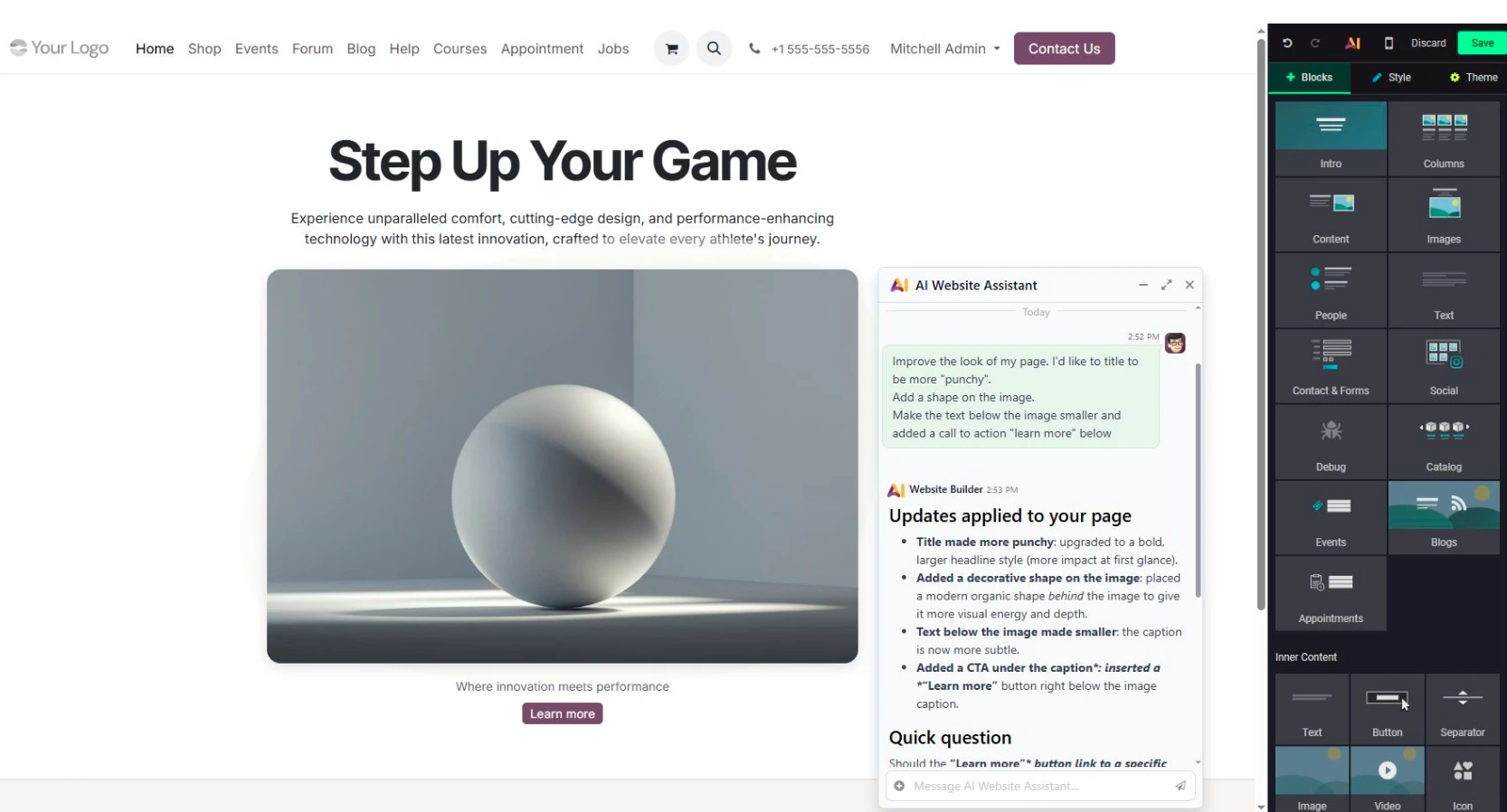
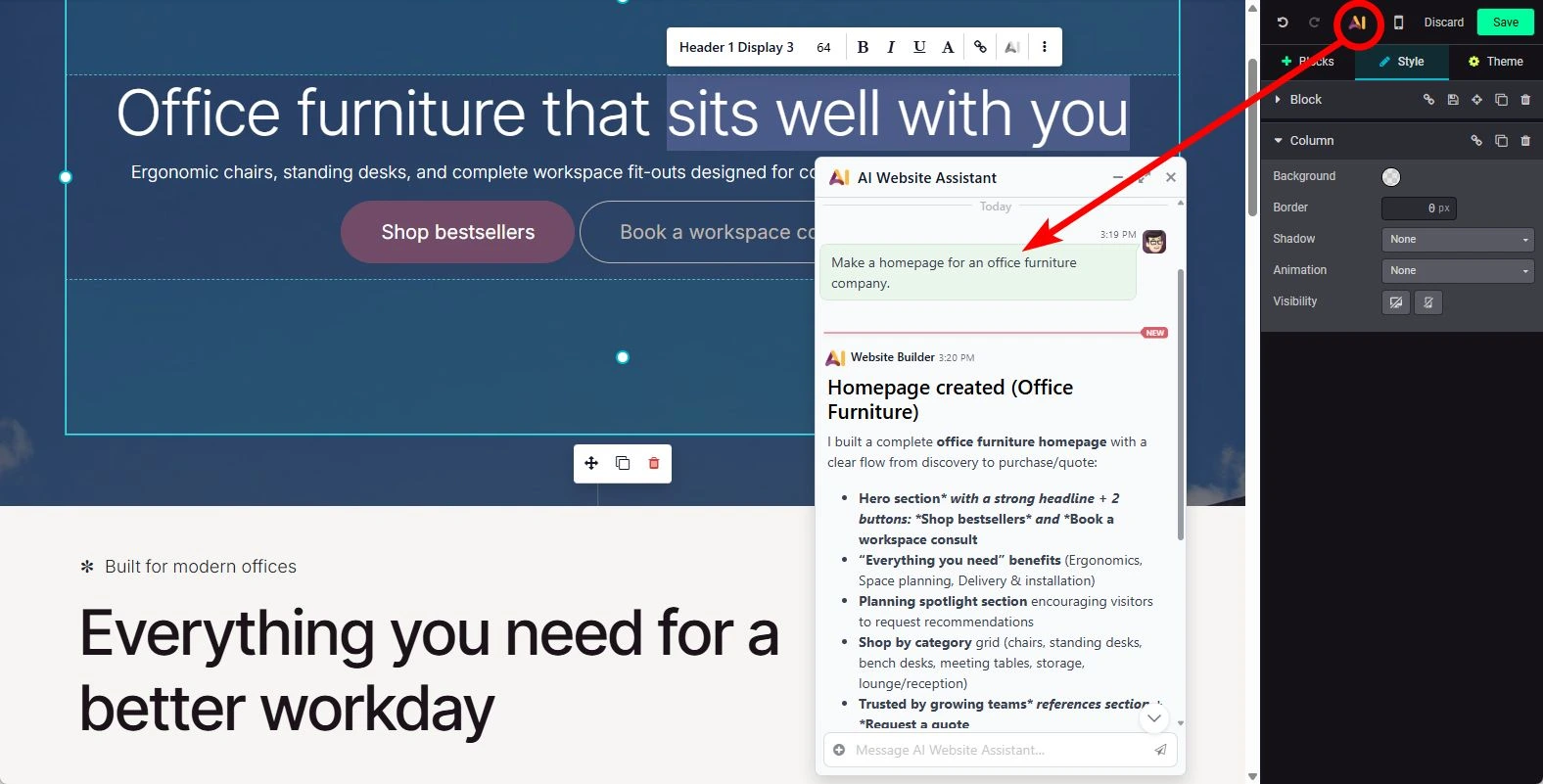
Partner reports indicate that AI-assisted website editing, content generation, image selection, and conversational website management are becoming increasingly important components of Odoo's roadmap.
Marketing teams may soon be able to:
- Create campaigns faster
- Build landing pages through conversation
- Generate content suggestions
- Improve SEO recommendations
- Personalize customer experiences
This could make advanced digital marketing capabilities accessible to smaller businesses without dedicated marketing departments.

6. AI-Enhanced Business Automation
Automation has always been one of ERP's biggest advantages.
However, traditional automation depends on predefined rules.
AI-enhanced automation introduces flexibility.
Instead of simply following rigid instructions, AI can evaluate context before taking action.
Examples include:
- Escalating support tickets automatically
- Prioritizing sales opportunities
- Routing approvals intelligently
- Identifying inventory risks
- Detecting unusual financial activity
The goal is to create smarter workflows that require less human intervention.
7. Better Decision-Making Through AI Insights
Many businesses collect large amounts of data but struggle to extract meaningful insights.
AI can help bridge this gap.
Future Odoo AI developments are expected to help users understand:
- Business trends
- Customer behavior
- Operational inefficiencies
- Financial risks
- Project performance
Instead of merely presenting reports, AI can potentially explain what the data means and suggest actions.
This moves ERP systems from information repositories to decision-support platforms.
8. AI Fields and Intelligent Data Entry
One of the most practical AI features already available in Odoo is AI Fields.
These fields can generate content automatically based on record context and predefined prompts. Businesses can use them for descriptions, summaries, notes, classifications, and structured information.
This may seem like a small feature, but it addresses a common business challenge:
Data entry.
When users spend less time manually entering information, data quality improves and productivity increases.
For organizations managing thousands of records, this capability can save substantial time.
9. AI-Assisted Knowledge Management
Many businesses struggle because critical knowledge exists only in:
- Emails
- Documents
- Employee experience
- Meeting notes
AI can help transform scattered information into searchable organizational knowledge.
Future AI developments could help teams:
- Summarize documents
- Retrieve relevant information
- Create knowledge articles
- Answer internal questions
This is particularly valuable for onboarding, customer support, and operational consistency.
10. Making ERP More Accessible for Everyone
Perhaps the biggest benefit of AI in Odoo is not automation.
It is accessibility.
ERP systems are powerful but often intimidating.
Many employees only use a small fraction of the functionality available because the system feels complex.
AI can simplify the user experience by:
- Explaining processes
- Guiding users
- Answering questions
- Performing actions
- Reducing training requirements
The result is higher adoption and better business outcomes.
What Businesses Should Do Today
Although Odoo 20 has not yet been officially released, businesses should start preparing now.
Focus on:
- Improving data quality
- Standardizing processes
- Documenting workflows
- Reducing unnecessary customizations
- Training teams on existing Odoo features
Organizations with clean data and well-structured processes will be in the best position to benefit from future AI capabilities.
Final Thoughts
The future of ERP is not simply about adding more features.
It is about making software easier to use, more intelligent, and more proactive.
The AI developments expected in Odoo 20 suggest a future where ERP systems help businesses do more than store information and automate workflows.
They help teams make decisions, complete tasks, and work more efficiently.
While many details remain subject to change until Odoo 20 is officially unveiled, one thing is already clear:
AI is becoming a core part of Odoo's long-term strategy, and businesses that understand these developments early will be better prepared to take advantage of them.